
Table Of Contents
- Introduction
- What is HoLEP surgery?
- Holmium Laser Enucleation of the Prostate
- What is the HoLEP procedure?
- HoLEP vs. TURP
- FAQs
Introduction
Benign Prostatic Hyperplasia, or BPH, can make it challenging to lead an everyday life. BPH can increase your frequency of urinating and create a sense of incontinence. Here, Laser Treatment For Enlarged Prostate invasive procedure that removes the excess tissue from the gland, can help with the urine flow. You can expect the feeling of incontinence to be resolved once the surgery is completed.
What is HoLEP surgery?
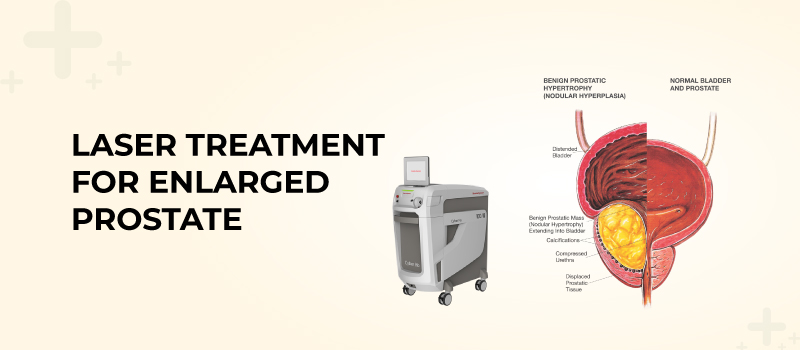
The first thing you must know about HoLEP surgery is that it uses a laser to remove excess tissue from the prostate. As it is minimally invasive, there is hardly any downtime post-operation. The urologist uses the Holmium laser to remove excess tissue that blocks urine flow through the urethra.
Holmium Laser Enucleation of the Prostate
Holmium Laser Enucleation of the Prostate (HoLEP) is not very painful. You will need an anaesthetic for the surgery, but the effects of the anaesthesia will wear off a few hours after the procedure. The surgery can remove the entire portion, blocking the urine flow. It requires no incisions and is more effective than the traditional surgical treatment method.
What is the HoLEP procedure?
The HoLEP procedure consists of several steps that begin with IV anaesthesia so that you are asleep during the surgery. Once the anaesthesia takes effect, the doctor will perform the following procedure:
- A resectoscope will be inserted into your urethra through your penis. The resectoscope has a camera, which allows the surgeon to see the prostate.
- The laser will be inserted through the resectoscope to break the excess tissue blocking the urine flow.
- The surgeon will push the excess tissue into the bladder.
- He will now replace the resectoscope with a morcellator to suck the excess tissue from the bladder.
- After the process, a catheter will be placed to drain your bladder.
HoLEP vs. TURP
HoLEP stands for holmium laser enucleation of the prostate, while TURP stands for transurethral resection of the prostate. Compared to TURP, there is less blood loss during the HoLEP procedure. Moreover, HoLEP can be performed even when you are on blood thinners, which is essential if you are a cardiac patient. A TURP cannot be performed if you are on blood thinners.
Finally, HoLEP is suitable for prostates of all sizes, whereas TURP removes excess tissue using electrocautery or sharp dissection, making it suitable only for very large prostates. Thus, if the hospital has a support system and the latest technology, surgeons often prefer HoLEP to TURP.
What is the cost of the HoLEP procedure?
The cost of the HoLEP procedure will depend on the hospital and your health conditions. If you have comorbidities and pre-existing medical conditions, the cost of the surgery will increase. However, on average, the surgery cost can range from ₹ 100,000 to ₹150000.
What should I expect after HoLEP surgery?
Some of the things that you can expect after HoLEP surgery are as follows:
- Once the catheter is removed, you can go home, but you might notice blood in your urine. Do not get alarmed, as there might be some blood in your urine for several weeks after the operation.
- Initially, passing urine will be painful, and you might have a burning sensation. The doctor will prescribe some painkillers that you must take to reduce the pain.
- The frequency of passing urine will increase after the operation. A few weeks after the operation, this will normalize.
- The urgency to urinate will also increase after the procedure. This will also stabilize a few weeks after the operation.
How long does it take to heal after HoLEP surgery?
It takes about six weeks to three months to completely heal from the surgery. The recovery timeline is as follows:
- You can leave the hospital in a day.
- You must avoid heavy lifting or physically strenuous activity during the first week.
- You can go back to work after two weeks.
- For two weeks, avoid any straddle activities such as riding a bicycle, lawnmowing, or driving a motorcycle.
After a month, you can resume your everyday life, but discuss with your doctor whether you can start your normal activities.
Conclusion
If BPH prevents you from living normally and compromises your quality of life, you must make an appointment with the top urologists at the Asian Institute of Nephrology and Urology (AINU). Our daycare facilities and state-of-the-art medical facilities will ensure that your prostate problem is resolved and that you can resume your everyday lifestyle. So, make sure to avoid BPH becoming a hurdle; contact us today.